


Happy Monday, folks!
Welcome back to Saintly CEO. Every Monday, while you sip your coffee, get some tactical advice to run your business fully in union with your Catholic faith.
Each week you’ll find…
IN TODAY’S ISSUE
News/Events: SF, Nashville + a new perk for the Guild
Feature Content: Make Generosity Your Entrepreneurial Compass
Heavenly Hustlers: 8 folks. From Gluten Free Flour to an Uber Competitor
Highlights: This Accounting Method Helps You Make Money
[read time: ~8.5 min | word count 1,845]

News / Updates
🚨🚨🚨 ICYMI: We recently launched the Faithful Steward. A free, private newsletter for Catholic investors to discover Catholic-run ventures raising money. A deal flow newsletter. It’s totally free. Sign up today. Builders, submit your deck here.
🎸 In Nashville? We’re hosting a hangout tomorrow night, sponsored by Lucid Private Offices.
🌉 In SF? We’re hosting a hangout after the Ascension Mass at Star of the Sea on May 14th. Details TBD, but sign up here to get notified.
🤠 In Houston? There will be an event the week of May 13th. Stay tuned for details.
🤖 We’re launching a new CF Guild perk. An AI bot that will answer questions from all of the CF content, and it will be able to help you meet other members of the Guild who can help you. To gain access, you’ll need to be a member of the CF Guild, so sign up today.
Join the Catholic Founders Guild Today
If you’re a Catholic, looking to launch and grow your business, Catholic Founders is made for you.
The Catholic Founders Guild is a place to learn from others, share resources, and build together.
We’re all on a mission to understand how God is calling us to be His hands in the world. We were born to carry out His will.
Join today for $100 a year or $10 a month.
Curious? --> “What is the Catholic Founders Guild”
Make Generosity Your Entrepreneurial Compass
As entrepreneurs, it is easy to measure success by the bottom line, the growth rate, or the market share. But for the Catholic business owner, those are secondary markers. The real question is whether your work is ordered to God.
At the center of this vocation is a radical call to generosity. It is the key that unlocks our identity as stewards rather than masters.
Stewardship Over Ownership
If God has blessed your business with more than your family and your enterprise need to live well, that surplus is not just a cushion for comfort — consider it a sacred trust. The mindset should really be that this is His. Thinking “how should I give away my things” would be the incorrect framing. All of it belongs to God in the first place.
“In his use of things man should regard the external goods he legitimately owns not merely as exclusive to himself but common to others also, in the sense that they can benefit others as well as himself. The ownership of any property makes its holder a steward of Providence, with the task of making it fruitful and communicating its benefits to others, first of all his family.” — (Catechism of the Catholic Church, 2404).
When we realize we are merely stewards, the temptation to stack up more and more dissipates. We begin to see our capital as a tool for the Kingdom.
The Entrepreneurial Fiat
To live this vocation well, your business plan must begin with a fiat. Like Mary, our response to God’s provision should be a total surrender of our professional path.
“Then Mary said, ‘Here am I, the servant of the Lord; let it be with me according to your word.’ Then the angel departed from her.” — (Luke 1:38).
This “yes” is not just a spiritual sentiment; it has to be practical. It must shape our time, our plans, and our use of money. You cannot follow God with your work while remaining closed-fisted.
Honoring God with Everything Over and Above
Scripture and Tradition are incredibly direct when it comes to how we handle the “extra.” The question is not, “How much can I keep?” but rather, “How can I honor the Giver with what remains?”
“But, when what necessity demands has been supplied, and one’s standing fairly taken thought for, it becomes a duty to give to the indigent out of what remains over. “Of that which remaineth, give alms.” — (Rerum Novarum, 22).
“Furthermore, a person’s superfluous income, that is, income which he does not need to sustain life fittingly and with dignity, is not left wholly to his own free determination. Rather, the Sacred Scriptures and the Fathers of the Church constantly declare in the most explicit language that the rich are bound by a very grave precept to practice almsgiving, beneficence, and munificence.” — (Quadragesimo Anno, 50).
We see this pattern throughout the Gospels. Martha “welcomed him into her home” (Luke 10:38). Mary sat at his feet and listened. Jesus “loved Martha and her sister and Lazarus” (John 11:5). And Joseph of Arimathea gave Jesus his own tomb, where he was “laid… in his own new tomb” (Matthew 27:60). These were people who made room for the Lord through the sharing of their home, their space, and their property.
Hire Catholic Offshore Talent
We help you find vetted Catholic offshore talent to help your business grow.
$500 upon hire and $500 if you’re still happy in 30 days.
Email us your needs -> hire in days -> admin@catholicfounders.com
A Mission, Not Just a Business
When we lead with a generous heart, our work takes on a mission-shaped purpose. We are not just building something for ourselves. We are building something that can serve God, serve the Church, and serve people in need. This is a direct imitation of Christ’s life of service.
That is what Catholic entrepreneurship looks like: faithful stewardship and open hands. Not a life focused on accumulation.
The Cheerful Giver
Ultimately, the goal is a heart that belongs entirely to God (because that’s what we’d have in Heaven). When we stop being selfish with our surplus, the grind of entrepreneurship becomes a joyful act of service.
Be generous toward God. When you do, your career can blossom into a path to holiness and a vehicle for delivering His will on Earth.
God Bless & Happy Building
~Silas Mähner
Interested in Investing in Catholic-run Ventures?
If you’re interested in investing in Catholic-run ventures, join our free, private newsletter for Catholic investors, the Faithful Steward.
Sign up. —> When we hear about Catholics raising money for their venture, we send an email out. —> If you’re interested, you can connect with them directly.
Please note: this is not just for venture-backed startups. Anything Catholic-run goes. Films, real estate, funds, venture-scalable startups, small brick and mortar businesses, etc.
It’s totally free. We’re just trying to use our position in the market to connect Catholic investors with Catholics seeking to raise money.
PS: If you’re raising capital, submit your deck here.

Heavenly Hustlers
These are other Catholic business owners. Nominate one (including yourself).
🚲 Patrick McFarland and Davide Thompson are co-founders of CARI, a campus-based alternative to DoorDash that helps employ students. This is a little bit of an over-simplification, but that’s the way I understand it. They are based in Nashville.
👩 Anna Saucier & Megan Gephar run Apostolic Fruit. Helping Catholic women lead healthy organizations. They run some really interesting retreats called Rest Boldly.
💼 Mark Mastroianni is building an app to help board members bring up the most critical things, and to help executives integrate the 12 levels of humility from St. Benedict. He’s generally doing a lot of things. A bit of a hustler. Based in the Indianapolis area.
🚗 Ryan Kreager is the CTO & Co-Founder of Rides2U. A high-trust ride-hailing network that only employs the people you’d feel comfortable giving your daughter a ride home at 1 in the morning. They do schedule ahead and have much better economics. He’s based in the South Bend area.
👻 Daniel Urdaneta recently launched a ghostwriting agency. He’s focused on serving Catholics, and he’s based in Argentina.
🍞 Emmett Ackerlund is commercializing his sister’s gluten-free flour recipe. Guy is sharp. Based out of NYC. I’m already on the waitlist for my wife’s gluten allergy.
🙋♂️ Nominate a Heavenly Hustler (including yourself) - It takes 1 min.
Thank you to Catholic Owned for helping us find some of these folks each week. Get listed today!
Get in front of 100s of Catholic Business Owners
Become a sponsor today --> Admin@CatholicFounders.com

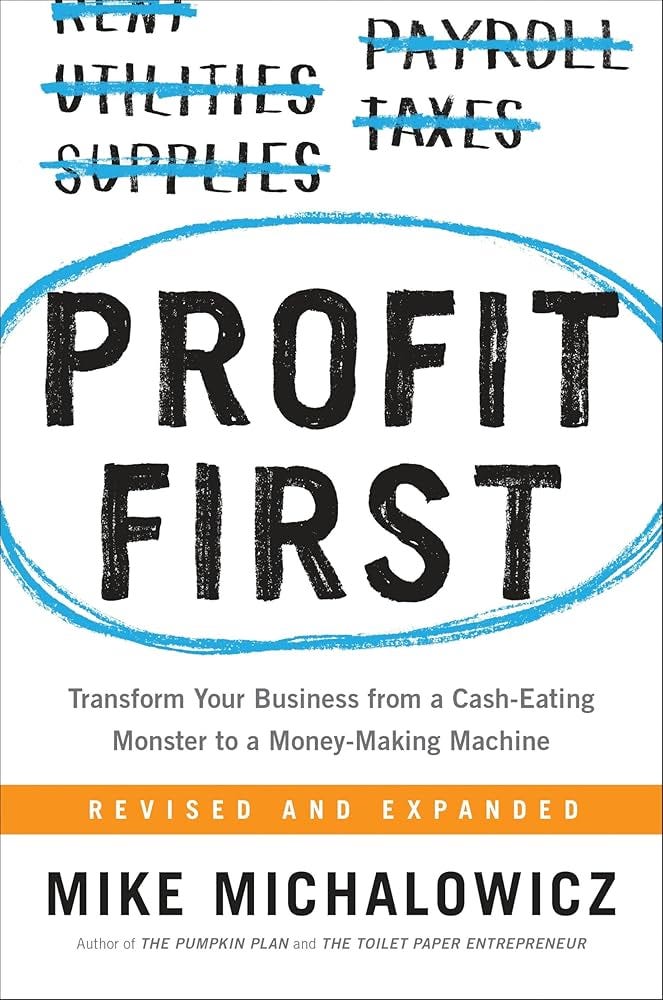
Highlight: An Ultra-Short Explanation of How to Use the Profit First Method
Many of the founders I encounter don’t take profit first. They have all their money in one bank account, making it hard to visualize how much burn you have left.
I get it. That’s what I used to do. Until I heard about the profit-first method of accounting. I’m not going to explain the whole thing, but will give you my version of it so you can (hopefully) be convinced to get the book and implement it and save yourself a lot of headache.
Instead of 1 bank account, you’ll have 5. Income, Owner’s Comp, Tax, OpEx, and Profit.
When you get paid, it goes to the income account.
Then, on a periodical basis (maybe once or twice a week), you’ll ‘balance’ the accounts.
Depending on your business, you’ll put x% into each account from your income account, leaving it with the minimum needed (I just keep $100 in it).
It might look like this. 10,000 comes into the income. 15% ($1,500) goes to profit, 20% ($2,000) goes to tax, 30% ($3,000) goes to OpEx, and the remaining 35% ($3,500) goes to Owner’s Comp.
At the end of the quarter, you can pay yourself a ‘bonus’ from the profit account. Usually, let’s say 50-75% of the value of the profit account.
The other key benefit here is that you’re ‘forced’ to make your company run on the allocated OpEx account, rather than forgoing your own compensation for the sake of the company.
This creates more discipline on spending, and will also help light a fire under your butt to get more sales.
Again, this is super ‘not official’ — this is just my read on it. But I’m confident a LOT of you would benefit from reading this book and implementing something similar to ensure you are actually making money rather than just scraping by.
Here is a huge list of various resources that we have complied overtime: The Ultimate Catholic Founders Resource Guide.
Feel free to bookmark it as we’ll continue to update it. And if you have suggestions on what to add, ping us (even if you want to promote your own stuff).
How did we do? Reply with 1 (Great 😄), 2 (Mid 🫤), or 3 (Needs Work ☹️)
I am going to start my day with Mary’s Fiat. It’s a beautiful encapsulation of what any Christian should offer.