
Saintly CEO: How to Integrate the Common Good Catholic Social Teaching Into Your Biz
Part 2 of our 4 part series covering, how to integrate the 4 pillars of Catholic Social Teaching into how we run our businesses.


Hey folks! Another Monday! Another potentially amazing week in front of us! It’s up to you to decide… 🚀
Welcome back to Saintly CEO. Every Monday, while you sip your coffee, get some tactical advice to run your business fully in union with your Catholic faith.
Each week you’ll find…
IN TODAY’S ISSUE
News/Events: SF, Dallas, Nashville, Wausau, Columbus
Feature Content: The Common Good. Pillar 2 of CST
Heavenly Hustlers: 5 Folks Building for God
Highlights: Biz Dev VA Hack
[read time: ~9.5 min | word count 2,071]

News / Updates
This week, Dallas is meeting. Next week, Nashville and Wausau. And then Columbus coming up in June.
Last week, we hosted a hangout in SF after the Ascension mass. Great turnout! Check out the picture here (and follow us on Instagram).
Listen to our most recent episode with Will Hickl — the man taking on Spotify! 🤯
ICYMI: Derek hosted a Growth Mastermind for the group. Check out the recording here if you missed it (guild members only).
Hire Catholic Offshore Talent
We help you find vetted Catholic offshore talent to help your business grow.
$500 upon hire and $500 if you’re still happy in 30 days.
Email us your needs -> hire in days -> admin@catholicfounders.com
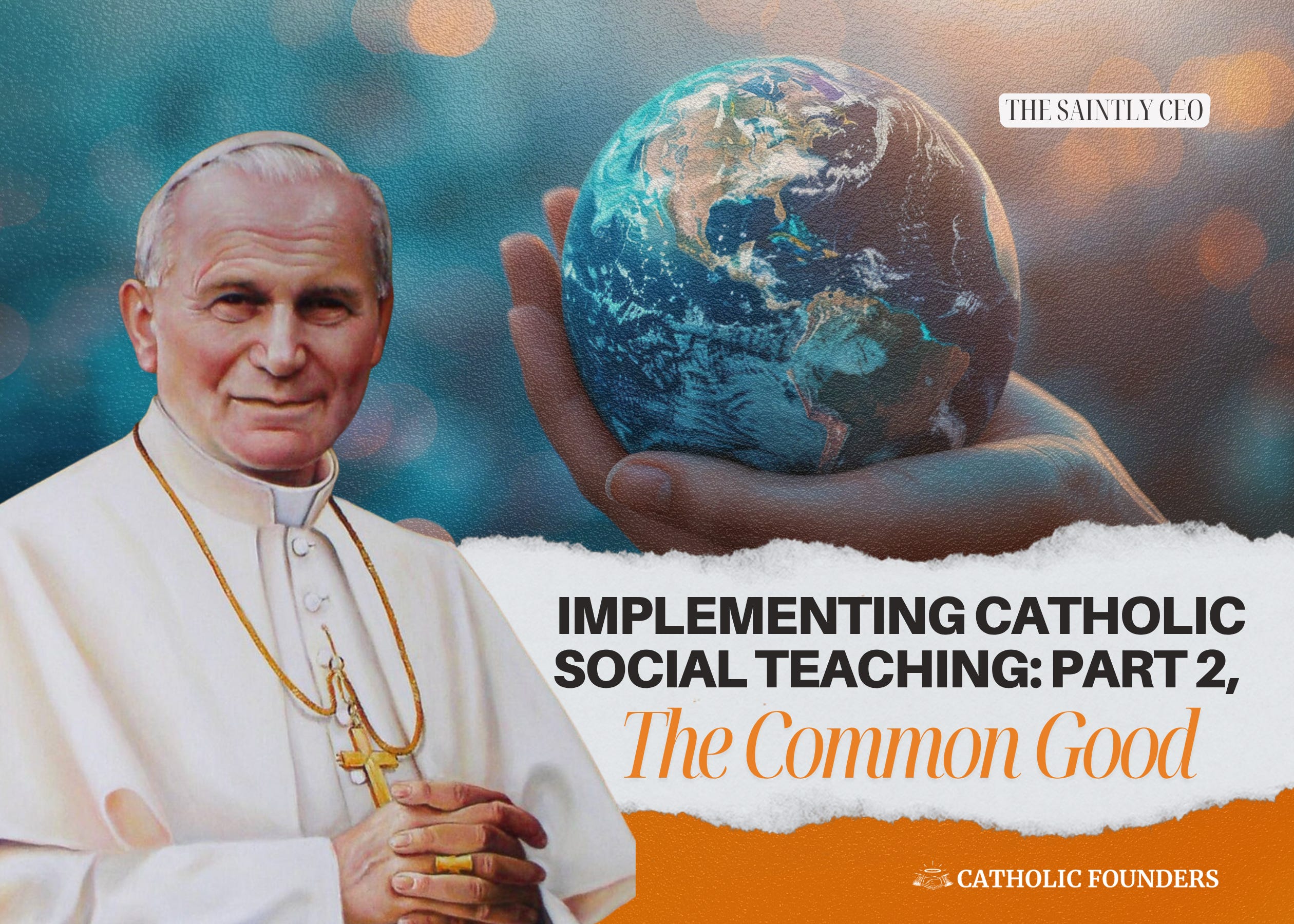
Implementing Catholic Social Teaching: Part 2, The Common Good
Last week, we discussed the first pillar of integrating Catholic Social Teaching into your business: Dignity of the Human Person. Today, we’re tackling pillar #2, The Common Good.
It’s especially important to discuss this because the current culture is heavily focused on the individual and merit alone. A sort of “pull yourself by your bootstraps” mentality is pervasive. This leaves many people at a substantial disadvantage. Something the new AI order is likely to exacerbate 100x.
Well! Enough pre-rambling — let’s get into it.
The Common Good: The Teaching
What exactly is the Church’s teaching about The Common Good?
Here’s the official quote from Catechism (1905-1906). It’s a little long, bear with me and read through it. Slowly and repeatedly if needed.
“In keeping with the social nature of man, the good of each individual is necessarily related to the common good, which in turn can be defined only in reference to the human person:
Do not live entirely isolated, having retreated into yourselves, as if you were already justified, but gather instead to seek the common good together. By common good is to be understood “the sum total of social conditions which allow people, either as groups or as individuals, to reach their fulfillment more fully and more easily.”
The common good concerns the life of all. It calls for prudence from each, and even more from those who exercise the office of authority. It consists of three essential elements:”
The common good is the sum total of social conditions that allow people, either as groups or as individuals, to reach their fulfillment more fully and more easily. For a CEO, this means success is not just about what is legal or profitable, but whether your operation contributes to the flourishing of society.” 1
Alright, let’s put our best Vatican-ese translation hat on.
Each person possesses infinite dignity as a person (because they are created in the image and likeness of God). And since we as persons exist in a society of other persons, we must not take actions that directly prevent or harm the ability of others to reach their fulfillment (flourishing).
In other words, since we have personal freedom, we must keep our fellow man (also a person and free being) in mind when we act.
This matters even more for those in positions of authority precisely because our actions directly impact the lives of many (not just one or two). We manager dozens or hundreds of employees. We may have thousands of customers. We can directly impact more lives with a single action than those not in authority. Our actions can either harm or help others.
Consider the example of a company owner. He has a hundred employees under his care. He could find ways to use the income generated through the company to benefit all of those employees as much as possible. Cultivating a positive culture. Making family-centered policies. Allowing for the flourishing of those 100 employees.
Alternatively, he could focus on maximizing his own take-home pay. He benefits (at least in the short term) at the expense of his employees.
The latter example is against the common good because he, as an individual, benefited while the other individuals suffered.
The Why
The why of this is quite simple. If personal gain is set as the ultimate good, it would lead to the degradation of many humans for the benefit of one or a few. In other words, if this were true, it would be impossible for everyone to pursue this outcome because some others inevitably would have to suffer.
By recognizing the dignity of each person around us, we are naturally inclined to share and care for those around us. This is directly in line with the Christian Charity that we are taught.
Join the Catholic Founders Guild Today
If you’re a Catholic, looking to launch and grow your business, Catholic Founders is made for you.
The Catholic Founders Guild is a place to learn from others, share resources, and build together.
We’re all on a mission to understand how God is calling us to be His hands in the world. We were born to carry out His will.
Join today for $100 a year or $10 a month.
Curious? --> “What is the Catholic Founders Guild”
That’s the what and the why of the second pillar. Now let’s dive into the 5 subtopics that go under this broader pillar.
Just like last week, we’ll give a brief description of each and then my perspective on how to integrate each one into your business.
1. Justice and the common good
Justice is giving each person what is due to them. Economic forces must be subordinated to the demands of social justice to ensure the whole operation serves a real good.
How to implement: Choosing how much to pay your team? Negotiating with your suppliers? Delivering the service you marketed to your customer? All of these are opportunities to practice justice. Pay fairly.
It must be understood that paying a just wage does not always mean paying market rate. Sometimes, a person cannot afford to feed their family on market-rate wages. If you’ve sold a certain service or product, you must deliver what was promised. If you don’t, you’re taking more than is just because the other party is now hindered in some way from flourishing, because you’ve taken more money from him than was just.
2. Conformity of social order to moral order
You cannot build a healthy business on a moral falsehood. Strategies and incentives must conform to objective moral law rather than just convenience or profit.
How to implement: Don’t participate in (or enable through services to) enterprises like pornography, drugs, IVF, contraception, etc. Any business that may be legal does not mean it’s sanctioned. It must not violate morality. Note, this would include refusing to supply any such enterprises with services that help them operate their business. Including software and financing.
You’d also need to avoid strategies such as ‘high-pressure’ sales because they are predatory in nature. As well as any other ‘strategies’ that would be considered immoral.
3. Private ownership vs. universal purpose of resources
While private property is a right, it has a social quality. The goods of creation are ultimately for the whole human race. Resources are entrusted to us to manage for the good of others. This is an interesting point to help us realize that our business is about far more than just making money. We are like employees of God who have a facility to manage. The purpose of the facility is to take care of other members of God’s creation.
How to implement: Consider if you grow food products or produce goods, giving some of your product away to those in need. To those who cannot afford but may be in need. View your assets as a tool for blessing others. Your employees, customers, your community, and the homeless. Any man who enters your life.
You’d should also empower your own employees to participate in this activity. To use their judgment to give away a pastry here and an oil change there, to those clearly in need.
4. Right to participate
People should not be arbitrarily excluded from the decisions that affect them. Social justice involves learning how to participate in the common order rather than dividing it.
At first glance, you might think this means something like ‘don’t be racist.’ It does. But it means a lot more.
How to implement: When making employee conduct policies and procedures, you should not exclude them. This is the problem with Private Equity bros making sweeping company policy decisions that affect people they have never met and who have had absolutely zero input to those decisions despite being the ones affected by them (this is against subsidiarity as well).
I cannot state this seriously enough. It’s critical. Just writing about this gets my blood boiling because the practice is so widespread.
5. Stewardship for creation
The environment and natural goods are resources entrusted to us for the common good. We have a responsibility to protect our common home for future generations.
How to implement: If a more sustainable option exists for an item in your supply chain, choose it. If you are a farmer, do not partake in harmful farming practices that degrade the property and make it impotent for future generations. Ensure your products or services do not lead to the destruction or harm of the environment.
Share! (It’s the just thing to do 😉)
Help us spread these ideas so more Catholic business owners can impact the culture through helping families flourish using these ideas.
It costs nothing to share and this is free to read. If we don’t promote these ideas, who else will?
There you have it. Join us next week to discuss Subsidiarity, the third principle. This focuses a lot on empowering your team.
God Bless & Happy Building
~Silas Mähner

Heavenly Hustlers
These are other Catholic business owners. Nominate one (including yourself).
🛜 Ed Burns is the Co-Founder of TruSygnal. Based out of Philly. They connect shippers and carriers directly for contract opportunities without the endless back-and-forth. He’s also one of the few guys who actually replies to me on Twitter (thanks bro!)
🏡 Blanca Agregado is the Founder of Tessell Studio, a commercial interior design and strategy consultancy serving organizations based out of Ontario, Canada.
💻 Ian Doromal is the Co-Founder & CEO of Continuous AI in the Orlando area. The tech prevents your AI agents from going HAM and using way too much compute.
👨🏻🍳 Keegan Conrey is the CEO of Decision Logic in the Omaha, Nebraska area. They help restaurant operators boost their growth. Their platform turns messy operational data into actionable decisions that help restaurants run smarter.
🎨 Joseph Hearney is the owner of Decree Design Co.®, a published branding and design studio based in Western, KY.
🙋♂️ Nominate a Heavenly Hustler (including yourself) - It takes 1 min.
Thank you to Catholic Owned for helping us find some of these folks each week. Get listed today!
Get in front of 100s of Catholic Business Owners
Become a sponsor today --> Admin@CatholicFounders.com

Highlights
Keeping this short bc this is already too long.
If you network a lot, hire an overseas EA so that instead of saying you’ll follow up, and don’t, you can just text a picture of each biz card to your EA and send a voice msg with the follow-up instructions. I learned this idea from Jimmy Coleman on the episode he did with us.
Here is a huge list of various resources that we have complied overtime: The Ultimate Catholic Founders Resource Guide.
Feel free to bookmark it as we’ll continue to update it. And if you have suggestions on what to add, ping us (even if you want to promote your own stuff).
How did we do? Reply with 1 (Great 😄), 2 (Mid 🫤), or 3 (Needs Work ☹️)